

How America’s travel industry keeps looking past leisure group travel
INDUSTRY ANALYSIS by Jeff Gayduk
The U.S. Travel Association recently published a report titled “U.S. Group Travel Report: Strength Beneath the Surface.” It opens by acknowledging that group travel encompasses business events, youth sports, live entertainment and, briefly, leisure groups. Then it spends the next 19 pages almost entirely on meetings, conventions, business travel headwinds, and the 2026 World Cup.
Leisure group travel’s appearance in the report is a single sentence in the methodology box on page two, where it is classified as an “adjacent segment.” Not a core segment. Not worthy of its own data, its own section, or its own strategic recommendations. Adjacent.
This ethos reflects precisely where leisure group travel sits in the American travel industry’s hierarchy of priorities. That institutional blind spot is costing destinations real money.
First, Look at Who Funded the Report
Before evaluating any industry research, look at who paid for it. The USTA’s group travel report was presented by IMEX, the world’s largest meetings and events trade show. Its research partners were Tourism Economics, Granicus (an event technology platform) and Maritz (a corporate event experience company). Supporting partners included Sports ETA, Marriott International, the Las Vegas Convention and Visitors Authority, Hyatt and Northstar Travel Group.
Every sponsor on that list has a financial stake in meetings, conventions, business travel or sports events. Not one tour operator. Not one organization representing the packaged leisure travel market. The report’s conclusions follow its funding, and they explain precisely why a report nominally about “group travel” has almost nothing substantive to say about the segment that put $39 billion into the U.S. economy in 2024.
What the Numbers Actually Show
That $39 billion figure comes from the American Bus Association Foundation’s 2024 Economic Impact of Motorcoach Group Travel study. It was conducted by Tourism Economics, the same firm that worked on the USTA report. Each dollar spent by group travelers rippled through the economy to generate more than double the initial business sales. That activity supported more than 515,000 jobs, with travelers contributing $13.2 billion in food and beverage spending, $7.5 billion in retail, $7.2 billion in recreation and $3.5 billion in lodging.
This is a major economic pillar of American tourism, not a tiny niche market.
“Tour operators can fill a lot of hotel rooms and seats in restaurants, theatres, attractions, and bring a lot of revenue to a DMO’s region, all with the arrival of a single motorcoach.” — Roland Neave, President/Owner, Wells Gray Tours
The Demographic Reality DMOs Are Missing
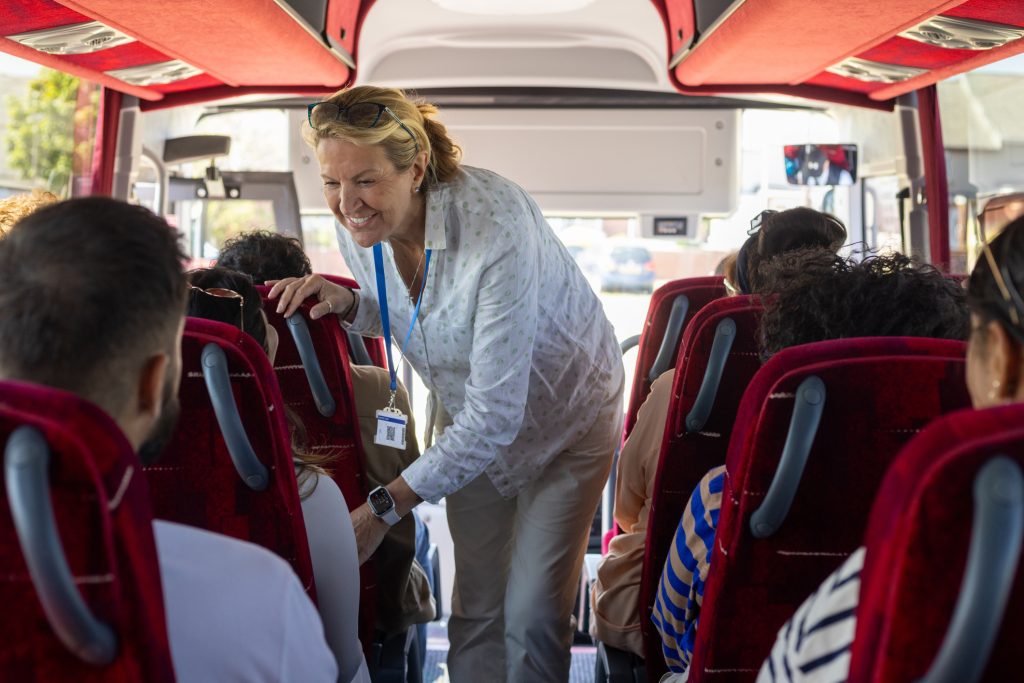
Adult leisure group travel is comprised primarily of Baby Boomers – ages 62-80. Important to know: Baby Boomers account for 80% of luxury travel spending in the United States. They spent roughly $6,450 per trip in 2024, up nearly $2,000 from the year prior, and 56% are willing to pay a premium for a quality experience. Group travel boomers take 3.3 trips per year accounting for nearly 37% of all travelers.
These are ideal destination visitors. They stay longer, spend more, travel in shoulder seasons, fill midweek hotel nights, eat at sit-down restaurants, visit attractions and shop locally. And crucially, they arrive pre-organized, pre-paid and pre-committed.
“Suppliers of all kinds should welcome this market. They know how many are coming 30 to 60 days in advance. Our groups are on a schedule and when presented with unique, authentic experiences, they are very appreciative. Plus, these groups typically come during the week, shoulder seasons, or on need dates.” — Elaine Moulder, Owner, Brilliant Edventures
While the USTA report identifies a growing preference for shared, in-person experiences as a major tailwind for group travel, that trend extends far beyond convention centers and business events. It is also visible on motorcoaches arriving at national parks, on riverboats exploring the Mississippi Delta, and on escorted tours winding through New England each fall. For many Baby Boomers, group travel combines the social connections they value with the convenience, security and planning support they increasingly seek. That is leisure group travel.
“Mature travelers are a very desirable demographic. And as we are seeing with the World Cup, not every big payday on paper actually turns into one in reality. Tour operators come year after year, not just for a special event.” — Mark Hoffmann, CTP, Owner, Sports Leisure Vacations
What Tour Operators Are Saying — and Who Isn’t Listening
At Accent West 2026, one of the group market’s leading regional trade shows, tour operators raised pointed criticism of destination marketing organizations: their websites fail the leisure group travel market. Destinations routinely bundle tour operators together with wedding planners, meeting coordinators and girlfriend getaways — the same contact page, the same PDF, the same form submission. For group travel planners, this can create the impression that their needs are not fully understood or prioritized.
The deeper problem is structural. When DMOs were forced to cut staff in 2020, leisure group travel sales managers — already a thin stratum of specialized expertise — were cut and when positions were rebuilt, they were weighted toward the segments with the strongest institutional advocates: meetings, conventions, and later sports tourism. The result is a gap between the market’s economic significance and the strategic attention it receives.
The Cost of the Blind Spot
Here is what makes the industry’s neglect of leisure group travel particularly difficult to defend: this market requires almost no capital investment to pursue.
To compete for a major convention, a destination needs a convention center, large hotel blocks, dedicated event infrastructure, and a sales team capable of responding to hundreds of RFPs. To compete for sports tourism, destinations across the country are spending tens of millions on purpose-built complexes. Local governments are investing $35 to $60 million in youth sports facilities to capture that market.
Leisure group travel asks for none of that.
According to the American Bus Association, a single group tour can inject $5,000 to $12,000 into a local economy in a single day through restaurant tabs, attraction admissions, retail purchases and hotel room nights. Most escorted tours don’t visit their destination for one day. A typical itinerary takes two to three nights. At the low end of the daily range, a group spending three nights generates $15,000 to $36,000 in direct local economic activity. From a single motorcoach. From a single booking.
“One conference comes to town with 1,000 attendees, and they might not come back for 20 years. A tour and travel company might bring two, three, four, or more groups every year and exceed 1,000 people in only five years. Those individual groups well exceed the spend — they’ll visit more attractions, eat at more restaurants. Group operators well exceed the economic impact of a conference or a tournament because they see the value of coming to a city.” — Jay Smith, Sports Travel and Tours
What does it cost to earn that business? A staff member. A website built for operators rather than lumping them in with wedding inquiries. A small marketing budget. A handful of trade show appearances per year at events like NTA Travel Exchange, ABA’s Marketplace or a host of regional trade shows.
Virginia Beach is one destination that understands this math. During the Virginia International Tattoo alone, the Virginia Beach CVB welcomed 62 motorcoach groups — a single event, 62 coaches, each generating thousands of dollars per day in direct local spending across hotels, restaurants, attractions and retail. Jim Coggin, Tourism Sales Manager for the Virginia Beach CVB, notes that the destination also excels as a hub-and-spoke market: “Groups can stay multiple nights in Virginia Beach and easily explore nearby regions, which increases length of stay and overall economic impact.” That multi-night structure compounds the per-day figures significantly. A group that stays three nights and day-trips to surrounding areas isn’t a one-day economic event — it’s a sustained injection into the local economy.
Virginia Beach offers a model worth replicating. Coggin holds a full-time position and is dedicated to the domestic group tour market for the United States and Canada. “My full-time focus is building and maintaining relationships with tour operators,” he says. “Every day, I am actively promoting Virginia Beach to this market.” The CVB also staffs a separate team member focused entirely on international inbound.
What also helps? A set of curated group experiences that go beyond the standard visitor itinerary — things like private museum tours before public hours, meet-the-chef dinners, exclusive access to local landmarks, behind-the-scenes experiences that can’t be booked individually.
The Market That Keeps Giving Back
The economics of leisure group travel don’t end when the motorcoach pulls out of town.
Tour operators build itineraries on trust. When a destination group contact is responsive, the experiences well-organized, the hotel delivers as promised; that destination goes into rotation. Not for just one trip but for years of trips.
“One group booking is worth multiple FIT bookings. We will keep bringing people back, especially to those places that work with us. We just had a group of 36 come back from a trip, and six months earlier another group of 42 from the same organization did the same trip — and their leaders said, ‘This was too valuable, we cannot wait another year to do this again.’” — Paul Larsen, Ed-Ventures
A convention delegate might return someday. A leisure group traveler who spent three days falling in love with your destination’s food, history, and character — guided by a well-designed itinerary and a host who understood the market — is far more likely to. And they’ll bring people back with them.
The Opportunity Is Not Complicated
Leisure group travel is a relationship business. Tour operators build itineraries years in advance, rely on trusted destination partners, and return to places that consistently deliver for their clients. Winning that business is less about infrastructure and more about demonstrating that a destination understands the market and is committed to serving it.
That starts with dedicated leadership. Leisure group travel performs best when someone is responsible for building relationships with tour operators, understanding their planning cycles, and advocating for their needs within the destination. It also requires destinations to create experiences designed specifically for groups and resources that make planning easier.
Just as importantly, destinations must invest in awareness and relationship-building. Planners cannot sell destinations they don’t know, and they cannot build itineraries around destinations that are absent from the marketplaces where business gets done. Consistent marketing, participation in industry trade shows, and regular engagement with operators send an important message: group travel matters here.
None of these investments are expensive. The destinations that make them will find themselves rewarded with repeat business, loyal partners, and a steady stream of visitors arriving throughout the year.
No convention center. No $50 million sports complex. No bond measure.
Just a person, a program, a plan, and the willingness to show up.
The destinations that embrace this market will build a market position that compounds year after year. Repeat group bookings drive additional visitation, generate valuable word-of-mouth among operators, and establish a reputation as a destination that understands and values the group travel business.
Sources
U.S. Travel Association, U.S. Group Travel Report: Strength Beneath the Surface (2026); American Bus Association Foundation, 2024 Economic Impact of Motorcoach Group Travel in the United States (Tourism Economics, 2025); American Bus Association, 2025 Motorcoach Economic Impact Report (Tourism Economics, 2025); Condor Ferries, Baby Boomer Travel Statistics 2025; Electroiq, Baby Boomer Statistics 2025; The Senior List, Senior Travel and Tourism Statistics 2026. Tour operator quotes collected by Leisure Group Travel, May 2026.